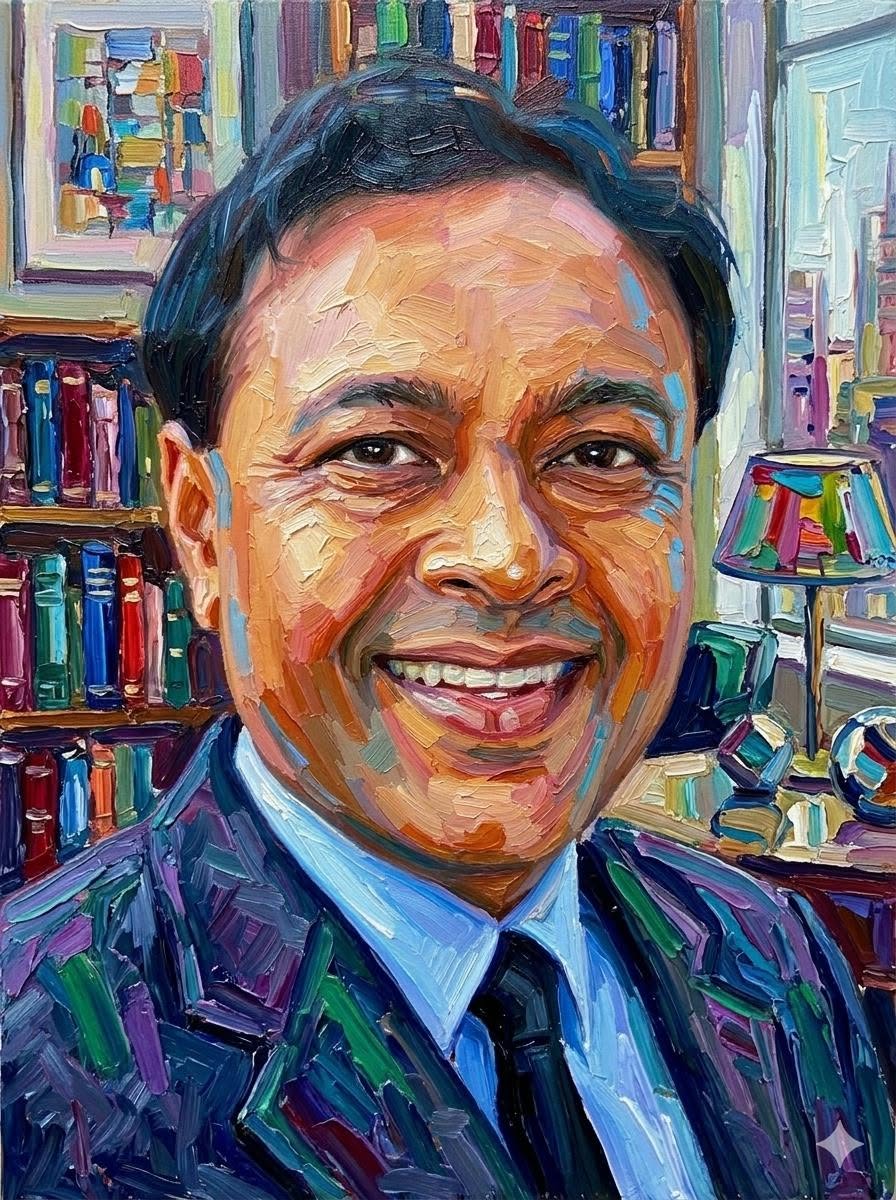
Swedish artist’s exhibition displayed Assamese author Dr Arnab Jan Deka’s portrait
Film with international collaboration to be released marking his 50 years’ journey
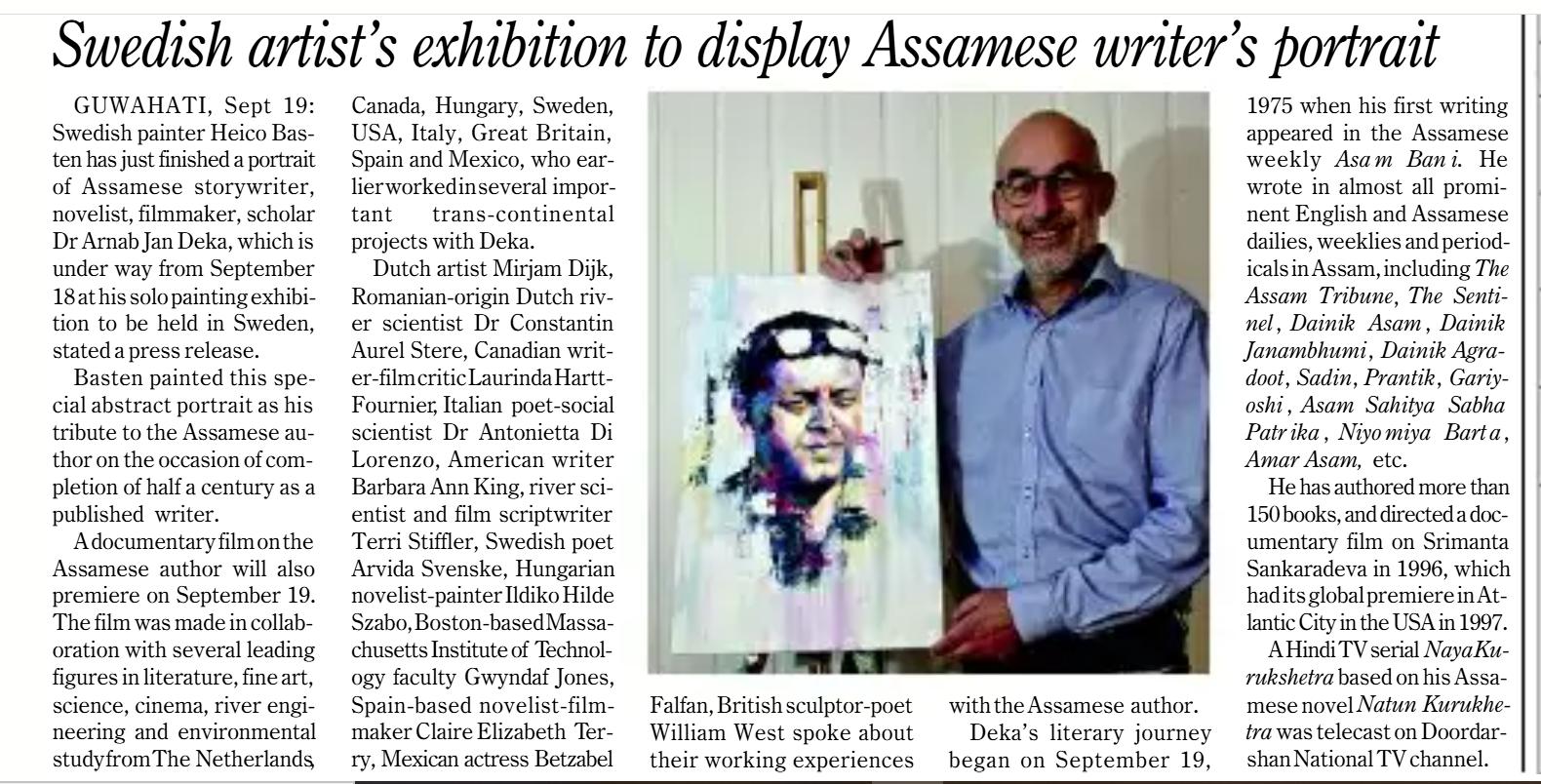
The Assam Tribune, 20 September, 2025
Reputed painter from Sweden Heico Basten has just finished a portrait of Assamese storywriter, novelist, filmmaker, scholar Dr Arnab Jan Deka, which was showcased from 18th of September 2025 at his solo painting exhibition held in Sweden. He painted this special abstract portrait as a mark of his appreciatory tribute to the Assamese author commemorating the significant milestone of the Assamese author’s completion of half a century as a published writer.
A documentary film on the Assamese author will also be premiered on this occasion, that was made in collaboration with several leading figures in literature, fine art, science, cinema, river engineering and environmental study from The Netherlands, Canada, Hungary, Sweden, USA, Italy, Great Britain, Spain and Mexico, who earlier worked in several important trans-continental projects with Dr Deka. Dutch artist Mirjam Dijk, Canadian writer, book editor, film critic and university teacher Laurinda Hartt-Fournier, Italian poet-social scientist Dr Antonietta Di Lorenzo, Romanian-origin Dutch river scientist Dr Constantin Aurel Stere, American writer Barbara Ann King, river scientist and film scriptwriter Terri Stiffler, Swedish poet Arvida Svenske and artist Heico Basten, Hungarian novelist and painter Ildiko Hilde Szabo, Boston based Massachusetts Institute of Technology faculty Gwyndaf Jones, Spain based novelist and filmmaker Claire Elizabeth Terry, Mexican actress Betzabel Falfan, British sculptor and poet William West and several others evocatively spoke about their working experiences with the Assamese author and several important other aspects.
Incidentally, Dr Arnab Jan Deka’s literary journey began on 19 September 1975 when his first writing appeared in the reputed Assamese weekly ‘Asam Bani’ and he went on writing in almost all prominent English and Assamese dailies, weeklies and periodicals in Assam including The Assam Tribune, The Sentinel, Dainik Asam, Dainik Janambhumi, Dainik Agradoot, Sadin, Prantik, Goriyoshi, Assam Sahitya Sabha Patrika, Niyomiya Barta, Amar Asam and also in many leading national and international research journals. Till the completion of half a century of this unique literary journey, he authored more than one hundred fifty books, and also directed the first documentary film on Srimanta Sankardev back in 1996, which held its global premier in Atlantic City in the USA in 1997. His novels and short stories had been adapted in Bollywood, and the mega Hindi TV serial ‘Naya Kurukshetra’ based on his Assamese novel ‘Natun Kurukhetra’ telecast over Doordarshan National TV channel went on to become outstanding success enjoying repeat telecasts since 2021.
Earlier, his monumental literary contributions had been acknowledged by the iconic Aligarh Muslim University with the official launch of two English books containing literary criticism and research papers on his works as well as English translations of some of his original Assamese short stories. Legendary historian Dr Irfan Habib and Booker nominated popular British novelist Dr Simon Andrew North officially launched these books at a function attended by prominent literary figures from India and overseas, where Dr Deka was also extended public felicitations by the AMU.
Recalling the literary contributions of departed scholars
The Sentinel, Guwahati, India, 30 Jan 2020, 12:32 pm
Prantik Deka
The 13th Principal Bhabananda Deka-Nalini Prava Deka Endowment Lecture was successfully organised by the Assam Foundation-India in a solemn function held at the Guwahati Press Club, recently. The function also coincided with the release of three books – Principal Bhabananda Deka Rachanawali, Nalini Prava Deka Rachanawali and Arnab Jan Deka Natyawali – a compendium of the stage and radio plays written by storywriter-novelist Arnab Jan Deka.
The programme was presided over by Dr Narendra Nath Sarma, eminent historian and former Professor and Head, Department of Library and Information Science, Gauhati University, and attended by noted personalities like actors Pranjal Saikia and Dinesh Das; former Editor of Natun Dainik, Dr Rohini Kumar Barua; Satyendra Prasad Deka, founder-president of All Assam Lawyers’ Association; writer Momi Borah; poet-physician Dr Sikha Sarma; poets Purabi Barua, Purabi Devi, Nizara Deka, Rinu Devi; scholars Dr Indrani Medhi, Rajib Hari Kaushik and Girindra Nath Deka, cine-journalist Arun Lochan Das; journalist Mukut Kumar Choudhury; adviser and president of the All Dimasa Students’ Union Prafulla Hafila, and Nabin Johori, respectively, among others.
The speakers, on the occasion, recalled the scholarly contributions of the eminent literary couple of the Awahon-Ramdhenu Era of Assamese literature – Bhabananda Deka and Nalini Prava Deka, and their selfless contribution in propagating and advancing the interests and glory of Assamese people. Guests of honour – Dr Rohini Kumar Baruah and Satyendra Prasad Deka, spoke about Bhabananda Deka’s pioneering works as an economist, his immense contributions to Sankari literature and ethnic communities like the Hajongs, Dimasas, Tiwas and the Karbis. They also spoke of his historic achievement in introducing Assamese as a subject, as well as a language in the all-India level competitive examinations conducted by the Union Public Service Commission (UPSC) and Delhi University during his stint in New Delhi, where he worked as a Senior Research Officer in the Language Unit of the Commission, in the late ’60s. Other speakers recalled the couple’s significant role in the making of the first film on the great 15th century Vaishnavite saint and social reformer, Srimanta Sankaradeva, which was globally premiered in 1997 at Atlantic City and Somerset in the United States of America.
The book by Arnab Jan Deka, which was released in memory of his parents – Bhabananda Deka and Nalini Prava Deka, is a precious resource. As popular Assamese film actor Pranjal Saikia recalled during his speech, Deka has always been inventive and conscientious. A long-time associate of Deka, Saikia felt that it was youthful passion and enthusiasm that ultimately led him to accomplish the arduous task of authoring several stage and radio plays that he wrote as a school-going boy during 1980-81, at the peak of the Assam Movement. The actor also recalled his experience of working with Arnab Jan Deka as a co-artiste in films and television serials. He described Deka as a meticulous person, who learned the craft of writing and filmmaking through perseverance and years of dedicated practice.
Senior film actor Dinesh Das spoke about Arnab Jan Deka’s work, both as an author and actor-filmmaker, and his absolute commitment in bringing out the works of his departed parents.
Poet-physician Dr Sikha Sarma and Purabi Barua read out two self-composed poems, eulogising the finer qualities of eminent scholar Principal Bhabananda Deka. All the speakers praised Arnab Jan Deka for painstakingly recovering and editing the complete works of the departed scholars and bringing them out for the public through a series of books.
https://www.sentinelassam.com/epaper.sentinelassam.com/saturday-fare/sight-sound-34
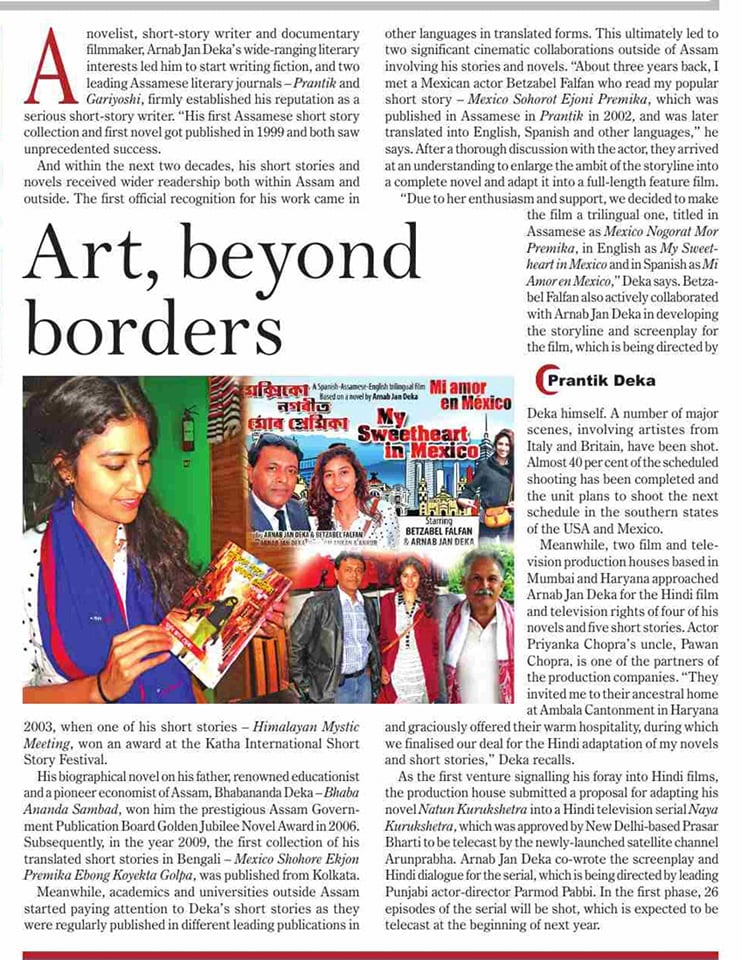
Art, Beyond Borders
by Prantik Deka
Assam Tribune, 22 October 2019
A prolific novelist, short story writer, poet, playwright, screenplay writer, documentary filmmaker, columnist, TV actor, river engineer, eco-technocrat all rolled into one, Arnab Jan Deka’s wide-ranging literary interests led him to start writing fiction just at the end of the twentieth century, and two leading Assamese literary journals – Prantik and Goriyoshi, firmly established his reputation as a serious story-writer in Assam. “My first Assamese short story collection in addition to my first novel got published in 1999, and both saw unprecedented success and were runaway hits among readers,” the celebrated author recalls. And within the next two decades, his short stories and novels received wider readership both within Assam and outside.
“In fact, I received far greater appreciation among the non-Assamese readers outside the state and even India through translation of my writings,” he says. Blessed with an analytical mind and a fertile imagination, Arnab Jan Deka’s first official recognition for his fiction work came in 2003 when one of his short stories – Himalayan Mystic Meeting, won an award at the Katha International Short Story Festival in New Delhi, where it was cited for its “skilful depiction of the essence of Indian heritage and how it blended with the universal philosophy of life”.
His biographical novel on his father, renowned educationist, author, scholar and a pioneer economist of Assam, Principal Bhabananda Deka – Bhaba Ananda Sambad, won him the prestigious Assam Government Publication Board Golden Jubilee Novel Award in 2006.
Subsequently, in the year 2009, the first collection of his translated short stories in Bengali – Mexico Shohore Ekjon Premika Ebong Koyekta Golpa, was published by a publisher from Kolkata’s College Street – a hallowed hub of Kolkata’s literary crowd. “That book received unprecedented popularity among the Bengali speaking public both in West Bengal as well as Bangladesh and opened up new vistas for my literary expedition,” he said. During the next few years, his short story collections got translated into several other languages and published in different corners of the globe, bringing rare recognition to the author.
Deka was also approached by the popular Assamese film actor-director Brojen Borah to adapt one of his popular novels – Soisobote Dhemalite, based on children’s rights to freedom and education, into a television serial in 2010. This serial was the swan song production of eminent producer-actor late Pramod Baruah.
Meanwhile, academics and universities outside Assam started paying special attention to Deka’s short stories as they were regularly published in different leading publications in other languages in translated forms. A leading university of South India – Manonmaniam Sundaranar University, incorporated three of his widely read short stories – Himalayan Mystic Meeting, Three Village Girls and Mother America, into the syllabus of their Masters Degree Program in English language, a rare achievement that Deka himself was, interestingly, unaware of in the beginning. “I only came to know about this rare honour when university and college teachers under that university contacted me online enquiring about publication of my storybook in English containing those three particular stories as they desperately needed my books to teach in classes and prepare research papers on my short stories,” he recollects.
These series of interesting events ultimately led to two significant cinematic collaborations outside of Assam involving his stories and novels. There is something enormously satisfying about seeing such efforts getting a favourable response. “About three years back, I met a Mexican actor Betzabel Falfan who read my popular short story – Mexico Sohorot Ejoni Premika, which was published in Assamese in Prantik in 2002, and was later translated into English, Spanish and other languages and was even published from Mexico,” he says.
After a thorough discussion with the actor, they arrived at an understanding to enlarge the ambit of the storyline into a complete novel and adapt it into a full-length feature film. The story depicts the common anthropological and geographical threads that binds together two extremely opposite cultures from two different corners of the globe into a cohesive force blended in humanism and romance.
Betzabel also proposed that a Spanish version of the film should be made, apart from English and Assamese, so that her fellow countrymen could enjoy the first cinematic collaboration between India and Mexico. “She told me that the Mexicans always look up to India for its rich cultural ethos and traditions, since their own ancient Maya and Aztec civilizations were destroyed by the Spanish invaders and the present generation of Mexicans have no link with their own past,” he says.
It is interesting to note that Betzabel herself learned Sattriya dance and opened a Sattriya dance school back in her hometown Leon. “Due to her enthusiasm and support, we decided to make the film a trilingual one, titled in Assamese as Mexico Nogorat Mor Premika, in English as My Sweetheart in Mexico and in Spanish as Mi Amor en Mexico,” Deka says.
Betzabel Falfan also actively collaborated with Arnab Jan Deka in developing the storyline and screenplay for the film, which is being directed by Deka himself. Music for the film will be scored by the talented duo Ankur-Ankan, both of whom have considerable exposure in multinational collaborative music. While Ankur has been more into classical genre and brought out several albums in different languages, Ankan specialises in lighter fusion music and has won several major international awards for his iconic song Awaaz, which was created as a tribute to the Delhi gang-rape victim. Both were lucky to have received tutelage from none other than the legendary artist Dr Bhupen Hazarika.
“We decided to incorporate an international cast of artistes from different countries, apart from Mexico and Assam, and accordingly proceeded in a clearly chalked out plan,” says Deka.
Accordingly, the film’s first phase of shooting has been wrapped up recently. During this schedule, the unit, lead by Deka, extensively shot in and around Brahmaputra, both over the river and on the north bank. A number of major scenes, involving artistes from Italy and Britain, have been shot. Almost 40 per cent of the scheduled shooting has been completed and the unit plans to shoot the next schedule in the southern states of the USA and Mexico.
Meanwhile, two film and television production houses based in Mumbai and Haryana approached Arnab Jan Deka for the Hindi film and television rights of four of his novels and five short stories. Popular Bollywood actress Priyanka Chopra’s uncle and Parineeti Chopra’s father, Pawan Chopra, is one of the partners of the production companies. “They invited me to their ancestral home at Ambala Cantonment in Haryana and graciously offered their warm hospitality, during which we finalised our deal for the Hindi adaptation of my novels – Natun Kurukshetra, Prem Asambhav, Xhoixobote Dhemalite and Xuxamoy Duxamoy as well as short stories Chitraxalar Xapon, Khalnayikar Hahi, Himalayan Mystic Meeting, Restless with Tess and Return of the Nightmare,” Deka recalls.
As the first venture signalling his foray into Hindi filmdom, the production house adapted his novel Natun Kurukshetra into a Hindi television serial Naya Kurukshetra, which was approved by New Delhi-based India government body Prasar Bharti for pan-Indian telecast in the Doordarshan National (DD-1) TV channel in October 2021. Arnab Jan Deka co-wrote the screenplay and Hindi dialogues and also officiated as associate director for the serial, which is being directed by leading Punjabi actor-director Parmod Pabbi. A number of artistes from Mumbai, Punjab, Haryana, Kolkata have been cast in important roles in the serial. In total, 26 episodes of the serial were shot and telecast in DD1 channel, and each episode is now available in YouTube.